

There will never be enough time
On existential urgency, panicking about Time and Toy Story 2

Lately, I haven’t had enough time. And as I write those words, I roll my eyes and can’t help noticing how generic, how very overused to the point of meaningless and frankly boring this refrain has become.
I didn’t have time. I ran out of time. I haven’t had time. Like a child grasping at the flimsiest of straws to justify why they haven’t done their homework. Yet I return to the thought time and time (and time) again. I’ve been telling myself, and everyone else, that I simply don’t have enough time for all the things I want in my life.
“I’ve had no time to myself recently,” I type, replying to a friend after leaving their message unopened for days. “I didn’t have time this week,” I tell myself when I don’t hit the number of workouts I promised myself I’d squeeze in. “I wish I had the time,” I say when someone asks about my painting hobby, and I think about the palette crusted in dried paint that has been gathering dust in the living room cupboard for months now.
It’s safe to say I’ve been feeling threatened by time. If it weren’t so scarce, if I just learned how to have enough of it, if I could just pause it to catch my breath, everything else would fall into place. The problem? Time is just all too inevitable. Too consistently consistent. It’s totally out of my control.
On the upside for me, and the downside for everyone that can relate, I’m not alone in this. Feeling overwhelmed by time passing is hardly a new sensation.
Some of my favourite wily writers of yore, the metaphysical poets, were all in on the inevitability of time. In the 17th Century, Andrew Marvell put it this way: “at my back I always hear / Time’s wingèd chariot hurrying near.” And although he penned this particular snippet as part of an elaborate seduction along the lines of “carpe diem, girl, let’s do it before our bodies decay,” it still rings true. That slippery fourth dimension chases us all.

The old Inevitability of Time conundrum has been on my mind constantly since I returned from a two-week travel stint in March. Among all the thousands of thoughts and feelings that flood your brain when you’re immersed in a new culture, one that kept popping up for me was an obsession with how precious that fleeting fortnight felt. Specifically, the idea that the trip was so precious because it was fleeting. Its transience created value. And I assigned emotional weight accordingly, piling pressure onto short moments I perceived to be ‘core memories’ in the making.
Happily, my hefty expectations paid off. My shiny new memories sweeten the sadness I feel about the moment’s ephemerality. But my value judgements on time make it move differently, whether I deem it worthwhile or wasted. When I think of time as precious, it seems to follow a stronger gravitational pull.
In other words, “time flies when you’re having fun” is one of the best and truest clichés around. How is it that time slows on the London Underground, so you feel every sweaty second stretching on? But when the beat drops in your new favourite song, you despair at the notion that music has to pass through time to exist, because you want to stay on that high note forever?
All of this is to say that I often feel simultaneous delight with a shadow of utter desperation at the fact that the present moment must inevitably pass and slip into memory.
This particular uncontrollable desperation, which I’ve started privately calling ‘existential urgency’, leads me to some very frantic thought patterns. So lately, I’ve been trying to identify where it might all be coming from.
Here’s what I’ve got so far:
30 under 30, etc.
I’ll use the Forbes 30 Under 30 as a shorthand for our society’s broader fixation on success in youth. You know the kind of thing I mean: the headlines for the youngest ever X to do Y. The obsession with prodigies. The fixation with debut authors. As Taylor Swift says, “people love an ingènue.”
The most recent example I can think of is Owen Cooper, the teenage star of the show Adolescence, who has (rightly) been getting heaps of praise for his astounding performance as a 13-year-old murderer. If you’ve watched episode 3, you’ll see why – his performance is chilling. What I find interesting is that Netflix has been deliberately playing up his lack of acting experience, seemingly to drum up excitement for the show and position him as a true whizz kid. But why are we so obsessed with the idea that a young person might spring out into the world as a fully formed genius, without help or support? It’s as though you need to be pure and untouched by life to have value. As though time and experience reduce the impact of achievement.
In the same vein, my friends and I are terrified of artists like Olivia Rodrigo, Billie Eilish, Lorde et al. who achieved crazy success at very young ages. Olivia was born in 2003 and already has 14 Grammy nominations, 3 Grammy wins and 2 platinum albums to her name. What does that make us? Are we running out of time to be impressive? Should we just give up now because we’re not getting any younger? Cue existential urgency.
The Beauty Industry of it all
Much of what counts as ‘self-care’ nowadays amounts to attempting to halt the effects of time from showing on your body. Jessica Defino writes best about the implications of an industrial complex that capitalises on fear of ageing in her brilliant newsletter, The Review of Beauty. To speedily paraphrase what I’ve taken away from her very astute insights, we do some pretty wild stuff – like putting acids on our faces – in the pursuit of holding back time. We want our appearances to be oblivious to time, and in wanting that, we spend hours thinking about the lines on our foreheads and hundreds of pounds on freezing them.
Once again, this is nothing new. The idea that time equals a loss of beauty goes back at least as far as Shakespeare, who gave us the corker that is Sonnet 12: “of thy beauty do I question make, that though among the wastes of time must go.” A little like Marvell’s poetic ploy, it’s a weaponisation of wit designed to encourage procreation. Before the Botox age, Shakespeare’s solution to fading beauty was that “nothing ‘gainst Time’s scythe can make defence / Save breed, to brave him when he takes thee hence.”
It begs the question: would Shakespeare have written Sonnet 12 if retinol were sold on the streets of Elizabethan London? I leave it to you to decide. Regardless, the tone of ‘what a shame for beauty to be ruined by time’ chimes strongly with our attitude nowadays, and feels like a likely suspect for causing existential urgency to bubble up.
Climate anxiety
Dread about time running out is perhaps most pressing in the form of climate anxiety. I realise that this is a Biggie to reference in passing, and other people have discussed this topic far better than I will, so I’ll just say that I’m sure it’s a culprit for existential urgency, and rightfully so.
The people who are saying it better: specifically Amanda Montell and Dharna Noor in this episode of Magical Overthinking, which I think walks the tightrope of hope, realism and nihilism in a compelling way.
The urge for incessant documentation
Since the age of 15 or so, I’ve used my phone’s camera roll as a backup drive for the memories in my brain. I used to use an app called Collect, where you take a picture every day to upload into a photo calendar. Then I moved to one called 1SE, which asks you to record one second of video every day, collating months of your life into easy-breezy highlights reels. After that, I used BeReal. It’s always something.
I fight a constant urge to capture videos, pictures, recordings, and archive my life as it happens. To curate any given moment while I’m still in it. To selectively crop and enhance my future memories by pointing my camera this way or that.
I rationally know that this tendency is unhealthy and even dishonest. I know cannot make a director’s cut of my entire life. Only having highlights in my camera roll won’t mean my life is only highlights. Sometimes, I get sick of the documentation mindset and want to opt out of clocks and calendars and cameras completely. Most of the time, though, I’m afraid my brain will stop recording if I put my phone down.
T.S. Eliot wrote in Burnt Norton that “If all time is eternally present / All time is unredeemable.” And listen, I know TS Eliot was not despairing about the state of the Instagram generation, but that same thread of reaching, grasping, and immaterial impossibility is there. “All time is unredeemable” feels like a slap to the face for someone in the grips of existential urgency, trying desperately to redeem the moments they felt most beautiful and loved and on-personal-brand. What do you mean, “all time is eternally present”? What if I don’t like the present? What if I’ve flattened myself into a memory-mood-board specifically for the purpose of escaping the present?? What if I’m never this young again and I don’t even have a picture to prove it???
While we’re here, I also want to gesture at the app that is a homonym for “Tick, Tock” and encourages our incessant self-archiving tendencies while simultaneously eroding our attention spans and perceptions of time. Pretty sure that’s another culprit right there.
Fear of not being young anymore
My friends and I are firmly in our late twenties now, and there are some serious Scaries going around as we approach thirty. Thirty feels like a strange, cosmic deadline. Almost everyone I know has one Big Life Goal or another they’d like to tick off before then, despite us all kind of knowing deep down that it’s an arbitrary milestone. I’m not sure what we think will happen after those thirtieth birthdays that will mean we can no longer achieve things. But we’re scared of getting older anyway. We’ve never not been young! So it’s natural, then, that becoming a little less young is scary. We’ve heard there might be back pain involved.
Literal time theft
A silly one, perhaps, but a cocktail of recent jet lag and daylight savings time has left me feeling cheated by the tricks of time zones and clock turns. Into this category, I’ll also throw alcohol. Intoxication is a kind of time travel, in that every drink today is an hour of normalcy borrowed from tomorrow, and the haziness in between is certainly “unredeemable” by many standards. Existential urgency is never stronger for me than when I’ve lost hours from my day, whether to time zones or tequila.
To infinity and beyond
Why am I collating this small list of big reasons to feel weird about time? I guess I’m trying to point out that the discomfort of existential urgency is everywhere. And I mean everywhere. Even the comfy places.
When my boyfriend and I were suffering from jet lag on our first day back in the UK after our travels, we decided to watch Toy Story 2. A simple, familiar storyline to soothe our frazzled and warped brains. We were surprised, then, by how deep Toy Story 2 gets when Woody realises (prompted by Jessie’s flashback set to the heart-rending “When She Loved Me”) that time comes for us all, in ways that hurt.
Woody’s conundrum of being a toy belonging to a child who will one day no longer play with toys is admittedly not super relatable. However, the fundamental panic we feel is the same. Time’s inevitability is so bittersweet; if only we could press pause and keep things as they are when they’re good. There will never be enough time for Woody to enjoy Andy’s childhood. Not even he is safe from time’s cruel wingèd chariot.
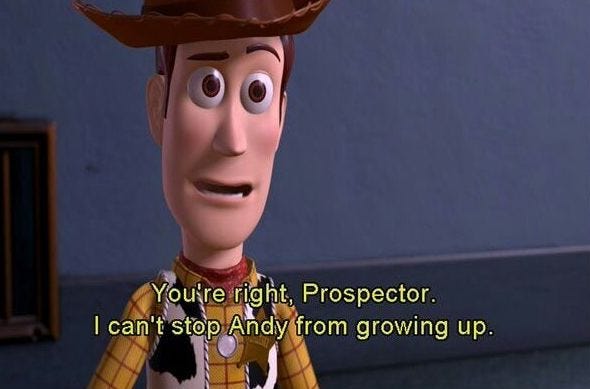
There will never be enough time. I’d bet that even if I had no job, shunned my responsibilities and followed my whims every day, I’d still feel a pang of panic when I realised the day is slipping away. I’d probably still fret about finite youth, beauty and opportunities to prove myself on this polluted planet hurtling through time. I suspect that existential urgency is not about circumstances at all, but feeling, and the wide and wacky factors that make that feeling swell up.
I’ll be returning to the topic of time anxiety in my next post. I haven’t found a solution to cure my timesick desperation, but I have come across a cool concept that helped me make some slight, uneasy peace with my existential urgency. Clue: it’s to do with words.
Until then, if I don’t post it for a while, I can confidently say it’ll be because I haven’t had enough time. 🍊